2025’s Split Reality: Premium Houses Surge as Overall Sales Dip
India’s real estate market showed a clear split in 2025. Premium homes priced above ₹1 crore accounted for around 62% of market value, posting about 4% sales growth between January and September, while overall unit sales across major cities fell 12% to 202,756 units. Demand in affordable and mid-income segments softened amid higher prices, cost pressures, and monsoon-related slowdowns.
Easier borrowing conditions offered some relief. The RBI’s repo rate cut to 5.25% by December helped home loan rates fall to 8.25–8.75%, improving affordability. At the same time, nearly 70% of developers expect prices to rise by 5% or more in 2026, citing steady demand and limited new supply. Post-pandemic trends continue to favour quality and location, with prices rising 13–16% in Bengaluru and Delhi-NCR, even as volumes signal a maturing shift.
Home Loans Near 8.25%: The Affordability Boost
Lower interest rates make 2026 a more attractive entry point for some buyers. A ₹50 lakh loan at 8.5% for 20 years translates to an EMI of roughly ₹43,000, compared with about ₹48,000 at 9.5%. With the repo rate at 5.25%, borrowers see limited but possible room for further easing if inflation remains under control.
Tax benefits add to the appeal. Buyers can claim up to ₹2 lakh in interest deduction under Section 24 for self-occupied homes and ₹1.5 lakh on principal under Section 80C, with additional relief under Section 80EEA for eligible affordable housing. Self-employed borrowers, however, may still face higher rates from NBFCs due to risk premiums. Budget 2026 whispers PMAY tweaks for mid-income.
Rent vs Buy: The Real Math for 2026
Renting offers flexibility but builds no equity. In Bengaluru, a typical 2BHK renting at ₹35,000 per month costs about ₹4.2 lakh annually, with limited tax relief beyond HRA or the ₹60,000 cap under Section 80GG.
Buying the same home using a ₹40 lakh loan can build ₹10 lakh or more in equity over five years, assuming steady appreciation, along with ₹50,000–₹60,000 in annual tax savings. With rents rising 5–7% a year and property values growing 8–10%, ownership often breaks even after around seven years.
In practice, renting suits shorter horizons <5 years, while buying works better for long-term stability and leverage.
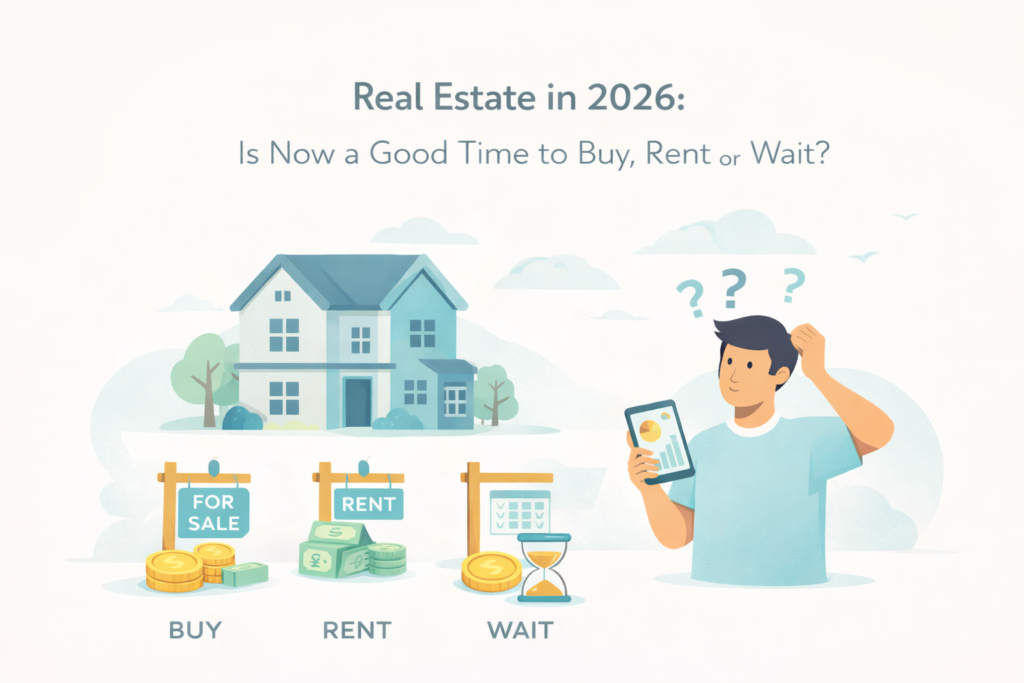
Buy Now, Rent Out, or Wait? What 2026 Signals Suggest
- Buy a house now or wait? Buy if ready—lower rates + infrastructure (metros, airports) fuel 7.3% GDP tailwinds; wait only if inventory piles up locally or rates dip further (unlikely pre-festive). Most developers see prices firming.
- Is real estate still a good investment? Yes, for 7-year-plus holding periods, delivering 15% total returns (rent 3-6% + appreciation) beats FDs/gold liquidity-adjusted. REITs remain a lower-ticket alternative, offering 7–9% yields with greater liquidity. Skip if illiquidity scares you.
- Rent or buy in 2026? Buy in growth corridors (Tier-2 boom); rent in oversupplied metros short-term. Ownership hedges inflation, rents don’t.
2026 Playbook: Act on Your Timeline
- Short-term (1-3 years): Rent, park savings in SIPs or REITs—avoid stamp duty/lock-in.
- Mid-term (3-7 years): Consider under-construction projects in job hubs and lock in current home-loan rates.
- Long term: A self-occupied home maximises tax benefits and lets EMI build wealth.
Rather than expecting sharp price corrections, many buyers are focusing on timing aligned with personal needs and local supply conditions. If you’re tracking a specific city or micro-market, local inventory trends matter more than national averages.
Thinking of buying, renting, or waiting in 2026? Share your city below.
For questions, collaborations, or deeper guidance, write to us at info@nomisma.club.
Disclaimer: This article is for educational purposes and not financial advice.