TL;DR for Confused Investors (Read This First)
If you don’t own much gold yet:
→ Start small. Use SIPs in Gold ETFs over the next few months instead of buying all at once.
If you already hold a lot of gold (jewellery + SGBs):
→ Don’t rush to add more. This dip doesn’t demand urgent action.
If you’re considering Sovereign Gold Bonds (SGBs):
→ Prefer fresh government issues. Avoid buying old SGBs from the market at a premium.
If you like higher risk and volatility:
→ Silver can move faster than gold—but limit exposure and use ETFs only.
Bottom line:
Gold still works as a hedge, not a shortcut. Think 5–10% of your portfolio, not an all-in bet.
Explaining the dip
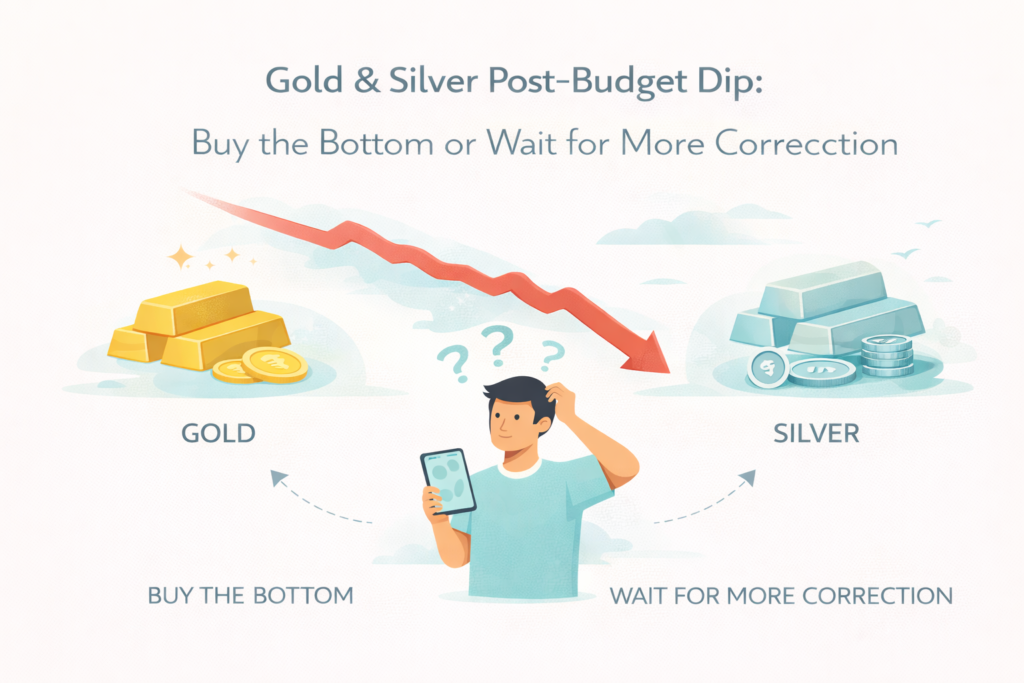
Gold and silver prices in India fell 6–9% within days of Budget 2026, with MCX gold sliding from near ₹98,000 per 10g to around ₹89,000–91,000, and silver dropping from ₹1.25 lakh per kg levels.
This wasn’t because gold suddenly became a “bad asset.” The fall came from a mix of policy tweaks, global cues, and investors locking in profits after a very strong 2025. For retail investors, this creates a familiar dilemma: buy the dip now, or wait for more correction?
Here’s what actually changed—and how to think about your next move.
What Triggered the Sharp Correction?
Three things came together right after the Budget speech on February 1:
1. Customs Duty Cut (Smaller Than It Sounds)
Customs duty on gold and silver dor bars was trimmed to 5% from 6%.
In reality, this doesn’t dramatically lower jewellery prices because GST and making charges still make up most of the final cost.
What it did do was give traders a reason to sell and lock in profits after gold’s 70%+ rally in 2025, accelerating the fall.
2. Sovereign Gold Bond (SGB) tax change — the biggest trigger
This is the most important shift to understand.
Earlier, investors could buy old SGBs from the stock market and still enjoy tax-free gains at maturity, even if they were not the original buyers. Many people did this purely to save tax, which pushed SGB prices 10–15% above gold prices.
From April 1, 2026, this tax-free benefit will apply only to original SGB subscribers, not to people buying them later from the market.
As a result:
- Investors holding expensive SGBs rushed to sell
- Premiums started shrinking
- Sentiment spilled over into gold ETFs and spot prices
3. Global Pressure Added Fuel
Globally, gold and silver also fell 4–6% as:
- The US Federal Reserve signalled rate cuts may come later
- The dollar strengthened
- Global investors reduced “safe haven” positions
When global prices fall, Indian prices usually fall more because we import most of our gold—even if the rupee is relatively stable.
Quick Reality Check: How Big Was the Fall?
| Metal | Pre-Budget Peak | Post-Dip Low | % Drop | Current (Feb 9) |
| Gold (₹/10g) | ~₹98,500 | ~₹89,200 | ~9% | ~₹91,800 |
| Silver (₹/kg) | ~₹1.25 lakh | ~₹1.12 lakh | ~10% | ~₹1.18 lakh |
Context matters:
After a steep run-up, such pullbacks are normal. Prices often stabilise around zones where buyers historically step in. For gold, that zone has been around ₹92,000–93,000, which explains why the fall slowed there.
Silver tends to swing more because part of its demand comes from industries like solar panels and electronics, not just investment demand.
Tax Changes Explained in Simple Terms
Sovereign Gold Bonds (SGBs)
- Original buyers: No change. Gains at maturity remain tax-free.
- Secondary market buyers: Tax-free benefit ends after April 2026.
- Expect 5–10% premium compression in SGB prices over time.
Gold ETFs and Digital Gold
- No rule change.
- Long-term gains (after 1 year): 12.5% tax on gains above ₹1.25 lakh.
- Example:
If you make ₹2 lakh profit, only ₹75,000 is taxed.
Physical Gold
- Short-term sale: taxed at your income slab.
- Long-term (3+ years): 12.5% LTCG.
Customs Duty Cut
- Saves about ₹600 per 10 grams at the raw import level.
- Most of this does not reach consumers due to GST and making charges.
Buy Now, Average Down, or Wait?
When buying the dip makes sense
- You want gold as a rupee hedge and safety buffer
- You currently have less than 5% exposure
- You are buying via ETFs or fresh SGB issues, not overpriced physical gold
- You understand that gold is protection, not a growth engine
- You understand silver can swing 20–30% easily
When waiting makes sense
- You already hold a lot of gold (especially jewellery)
- You recently bought SGBs from the market at a premium
- You’re uncomfortable with short-term volatility
- You prefer clarity over catching the exact bottom
A practical middle ground
For most Indian retail investors, the sweet spot remains:
- 5–10% total allocation to gold and silver
- Prefer Gold ETFs or primary SGBs
- Use monthly SIPs instead of lump sums
- Treat jewellery as consumption, not investment
Silver can be added via ETFs if you are comfortable with sharper price swings, but keep exposure smaller than gold.
Action Steps You Can Take This Week
- Check your exposure
If gold + silver already exceed 15% of your total portfolio, avoid adding more. - Restart or begin SIPs
₹5,000 per month into a Gold ETF reduces timing risk and regret. - Avoid emotional buying
Jewellery purchases should be driven by life events, not market dips.
Bottom Line
The Budget clarified tax rules and removed a pricing distortion, but it did not break gold’s role in a portfolio. Gold still works best as insurance, not a moonshot.
Position for volatility, stay disciplined on allocation, and let time do the heavy lifting.
What’s your gold exposure right now—adding, holding, or waiting?
For questions, collaborations, or deeper guidance, write to us at info@nomisma.club.
Disclaimer: This article is for educational purposes and not financial advice.