
Why Most Budgets Fail (And How to Fix That)
Most people do not struggle with math; they struggle with a plan that is too strict or too vague. A budget that actually sticks needs three things: it must be simple to remember, flexible when life changes, and clearly show where your rupees go each month. For salaried Indians, that means accounting for rent, UPI swipes, EMIs, and SIPs in a way that still leaves room for fun.
The 50/30/20 Rule: A One‑Line Budget
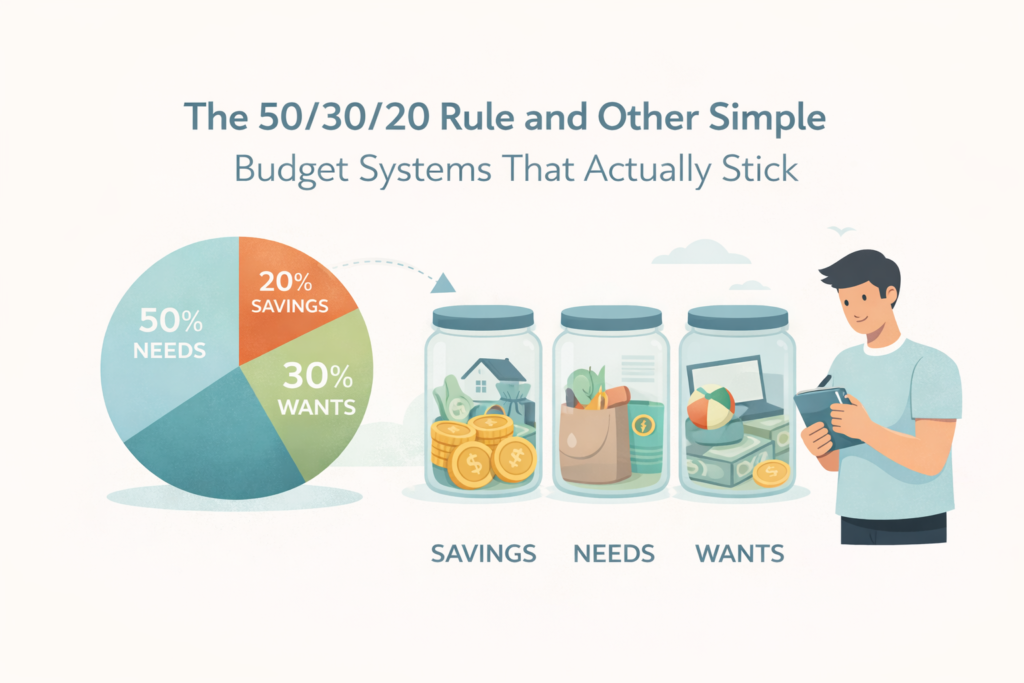
The 50/30/20 rule says: As a starting framework, 50% of your take‑home income goes to needs, 30% to wants, and 20% to savings and investments. Needs are non‑negotiables like rent, basic groceries, mobile/Internet, essential transport, and minimum EMIs; wants are Zomato orders, weekend outings, travel, subscriptions, and impulse UPI spends. Savings and investments include your SIPs, RD/FD contributions, emergency fund, and extra loan prepayments.
In an Indian context, a ₹60,000 in‑hand salary might look like this: ₹30,000 for needs (₹18,000 rent/PG, ₹4,000 groceries, ₹3,000 transport, ₹5,000 EMIs and bills), ₹18,000 for wants (eating out, movies, trips, online shopping), and ₹12,000 for SIPs, RDs, and building a 6‑month emergency buffer. If your city is expensive and rent alone eats 40–50%, you can temporarily adjust to 60/20/20, but keep pushing needs down over time.
Zero‑Based Budgeting: Give Every Rupee a Job
Zero‑based budgeting flips the usual “spend then see what’s left” approach. At the start of the month, you assign every rupee of your income a purpose—so Income – Expenses – Savings = 0 on paper. That does not mean you have zero in the bank; it means everything is pre‑decided: fixed bills, groceries, UPI pocket‑money, SIPs, even a “guilt‑free” fun category.
For example, if you take home ₹80,000, you might map it like this: ₹20,000 rent, ₹6,000 groceries, ₹4,000 utilities, ₹6,000 transport/fuel, ₹10,000 EMIs, ₹15,000 SIPs/investments, ₹5,000 emergency fund, ₹7,000 eating out and Swiggy, ₹4,000 shopping, ₹3,000 travel savings. When you hit the limit in a category—for instance, your UPI “eating out” envelope—you stop, not swipe another credit card. Apps and simple Excel sheets work well for this.
“Pay Yourself First”: Treat Savings Like a Mandatory Bill
“Pay yourself first” means savings and investments go out before you start spending, not after you see what’s left. The moment your salary hits, you auto‑debit SIPs, recurring deposits, or transfers to a separate savings account, just like an EMI. Whatever remains is what you are allowed to spend on needs and wants.
In India, this can be as simple as: salary on the 1st, SIPs for mutual funds on the 3rd, RD on the 5th, and an automatic transfer to an “emergency fund” account. If you decide that 25% of your income is “pay yourself first,” then on ₹50,000 in‑hand, ₹12,500 leaves your main account automatically, and you learn to live on ₹37,500. Over time, these auto‑payments become invisible—your wealth grows in the background without daily willpower.
India‑Flavoured Examples: Rent, UPI, and SIPs in Practice
A realistic structure for a 25‑ to 35‑year‑old in a metro could combine all three systems rather than choosing just one. You might use the 50/30/20 percentages as a rough guide, zero‑based budgeting to plan detailed categories, and “pay yourself first” to lock in SIPs and safety‑net savings. Rent and EMIs sit firmly in the “needs” bucket; UPI micro‑spends get their own “wants” sub‑category so you can see how much is vanishing into coffee and delivery; SIPs into equity funds, gold, or NPS form the backbone of the 20% saving/investing piece.
If your income is irregular (freelancing, commissions), you can still pick a base number—say the average of your last six months—and budget off that while sending any extra to a buffer or extra investments.
👉 The key is not perfection; it is choosing one system you can follow on a sleepy Monday night and sticking with it long enough for the results to show up in your bank balance.
For questions, collaborations, or deeper guidance, write to us at info@nomisma.club
Disclaimer: This article is for educational purposes and not financial advice.


Pingback: New Tax Rules for 2025–26: What Changes for Your Salary, Investments, and Gold? - Nomisma Club
Pingback: How to Make Your Money Work for You in 2026 - Nomisma Club
Pingback: 5 Global Trends That Will Shape Your Money in 2026 - Nomisma Club